



Financial Aid
Cost should never be a barrier to higher education. We're committed to helping you find ways to minimize your expenses.
Requirements for financial aid assistance:
- Must be either a citizen or eligible non-citizen of the United States
- Must have a valid Social Security number
- For federal aid, must be enrolled in a degree or eligible certificate program*
- For student loans, must be enrolled at least half-time (6 credits)
- Cannot owe a refund on a federal student grant nor be in default on a federal student loan
- Must meet minimum standards of academic progress as outlined in the Champlain College Online Undergraduate Student Handbook and the Champlain College Graduate Catalog.
* All certificate programs, undergraduate and graduate, must be submitted to the Department of Education (DOE) for review and approval before students can utilize Federal financial aid to pay for them. The following certificate programs are awaiting that approval, which means they currently do not qualify for financial aid but we anticipate their approval shortly. If you have questions, please contact your enrollment coach or email us at onlineadmissions@champlain.edu
Submitting the FAFSA
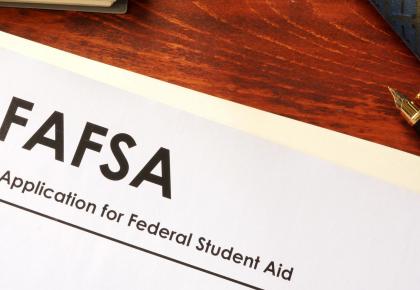
The Free Application for Federal Student Aid (FAFSA) is our official application for federal aid and is also required by most states in their grant application process. Our Title IV School Code is 003684.
Submit your FAFSA information as soon as possible, even if you have not completed the application process. That way, when you are accepted and ready to register, your financial aid paperwork will already be underway, and you won't be stuck waiting for confirmation of your financial aid status.
Once you've filed the FAFSA, you will receive an award letter outlining the financial aid available to you based on tuition, expected personal contribution, how far along you are in your program, and whether you're enrolled full-time or part-time.
Federal Student Aid Updates: One Big Beautiful Bill Act
The One Big Beautiful Bill Act (H.R. 1) was signed into law on July 4, 2025, and introduces significant changes to federal student aid programs. These updates affect loan limits, repayment plans, and eligibility rules, and will be phased in starting July 1, 2026, with some provisions already in effect. To learn more details, go to the section below labeled Federal Student Aid Updates.
Financial Aid Options
Federal financial aid is one of the most common types of financial assistance available to students and is typically the best option for students looking to fund their education, offering better interest rates and more flexibility than other forms of financing. Federal aid is available in the form of grants and loans.
Federal Loans
Champlain College participates in the Federal Direct Loan program, which allows students to borrow federal funds to help meet educational costs. Loans must be used for educational expenses. Students are responsible for repaying the amount they borrow, with interest, upon program completion.
Loans are available to those who qualify once accepted to a degree or eligible certificate program. For undergraduate programs, you must be enrolled at least half-time (taking a course load of 6 or more credits per semester) to qualify. For graduate programs, you must be enrolled in at least 3 credits to qualify. For certificate programs, please contact your Admission Representative or your Student Success Advisor for the most up-to-date information on which certificate programs are eligible for financial aid.
Loan options include:
- Direct Subsidized Loans: Loans made to eligible undergraduate students who demonstrate financial need.
- Direct Unsubsidized Loans: Loans made to eligible undergraduate and graduate students. Eligibility is not based on financial need.
- Direct PLUS Loans: Loans made to graduate students and parent of a dependent undergraduate student to help pay for education expenses not covered by other financial aid. Eligibility is not based on financial need, but a credit check is required.
Learn more about subsidized and unsubsidized loans here.
The amount of money you can borrow will vary. Keep in mind when planning your educational journey that there are both yearly and lifetime limits on the amount of financial aid available to any individual.
- Undergraduate Independent Students can borrow a maximum of $9,500 – $12,500 per award year in Direct Subsidized and Unsubsidized Loans, depending on how far along in your program you are, prior loan borrowing, and Cost of Attendance.
- Undergraduate Dependent Students may be able to borrow a maximum of $5,500 - $7,500 per award year in Direct Subsidized and Unsubsidized Loans, based on how far along you are in your program, prior loan borrowing, and Cost of Attendance.
- Graduate or Professional Students can borrow up to $20,500 each year in Direct Unsubsidized Loans. Direct PLUS Loans can be used for the remainder of college costs not covered by other financial aid.
For further information on federal loans, such as current interest rates, visit www.studentaid.gov.
Federal Grants
Federal grants are a good option for students who need to supplement federal loans without increasing their debt load, as grants do not need to be repaid. Federal grants are need-based and available to certain groups of students.
Federal Pell Grants are one of the most common grant types, and are awarded only to undergraduate students who demonstrate financial need and have not previously earned a bachelor's degree. Students eligible for any amount in a Federal Pell Grant will also be awarded a small Federal Supplemental Educational Opportunity Grant determined by the Financial Aid Office.
Information on other types of federal grants can be found here.
Champlain's financial aid office can work with you to determine which grants you might be eligible for.
Grants are also available from state governments. These grants vary from state to state, and amounts, requirements, and eligibility will depend on the specific program you are participating in. A full list of state-specific grant resources can be found on the U.S. Department of Education website.
Vermont State Grants
If you're a Vermont resident, you may be eligible to receive grant money from the state through VSAC. To learn more about Vermont state grants, visit the VSAC website.
Champlain offers a variety of ways to save on your education, including:
- Transfer Credit
- Credit for Prior Learning
- truED Preferred Pricing
- Employer Reimbursement
- Military and Veteran Benefits
- Single Parent Scholarships (Vermont residents only)
- Private Scholarships
- Education Tax Benefits: Tax credits, deductions, and savings plans can help taxpayers with their expenses for higher education. For more information visit the IRS website.
We also offer flexible payment plans for those who wish to stagger their payments across a semester rather than paying a lump sum at one time.
Federal Student Aid Updates: One Big Beautiful Bill Act
The One Big Beautiful Bill Act (H.R. 1) was signed into law on July 4, 2025, and introduces significant changes to federal student aid programs. These updates affect loan limits, repayment plans, and eligibility rules, and will be phased in starting July 1, 2026, with some provisions already in effect.
Whether you are a currently enrolled student, a parent of a current or incoming student, or a recent or former student, these changes may affect how you apply for aid, borrow, and repay student loans. Stay up to date on federal regulations as they are made available at https://studentaid.gov/announcements-events/big-updates
New borrowers will face annual and aggregate limits for the first time. Historically, Parent PLUS loans covered the full cost of attendance with no specific dollar cap.
- Annual limit: $20,000 per dependent student
- Aggregate limit: $65,000 per dependent student
- These limits apply regardless of prior forgiveness, repayment, or discharge status — prior loan cancellation does not reset a borrower’s eligibility toward these caps.
Applies to borrowers whose first Parent PLUS loan was disbursed before July 1, 2026.
- May continue borrowing up to the student’s full Cost of Attendance (COA) minus other aid, for the lesser of three academic years or the student’s expected time to credential.
- The dependent student must remain continuously enrolled in the same program.
Institutions are now required to prorate the annual loan limit for undergraduate students enrolled less than full-time (fewer than 12 credits per semester.
Applies to students who had no Graduate PLUS loan disbursed prior to July 1, 2026.
- Graduate PLUS loans will no longer be available.
- Borrowing is limited to the Direct Unsubsidized Loan annual limit of $20,500.
Applies to students who received a Graduate PLUS loan before July 1, 2026.
- May continue borrowing up to full COA minus other aid, for the lesser of three academic years or the expected time to credential.
- Must remain continuously enrolled in the same program.
- Institutions are now required to prorate the annual loan limit for graduate students enrolled less than half-time (fewer than 6 credits per semester), including courses dropped after a loan disbursement has been made.
Note: Students enrolled in a program of study as of June 30, 2026, who borrowed any type of Direct Loan for that program before July 1, 2026, may qualify for the Graduate PLUS legacy provision.
- Direct Unsubsidized Loan annual limit is unchanged at $20,500.
- New aggregate limit of $100,000 for graduate borrowing only (excluding undergraduate loans). The previous aggregate limit was $138,500 and included undergraduate loans.
New lifetime maximum of $257,500 for all federal student loans combined, excluding PLUS loans.
Several federal student loan repayment and forgiveness programs are being phased out by July 2028, including SAVE, PAYE, and ICR. Income-Based Repayment (IBR) is not being eliminated but is being restructured — details are still being finalized.
New options outlined in the legislation include the Repayment Assistance Plan (RAP). However, many implementation details remain uncertain.
- Stay in contact with your federal loan servicer for updates specific to your loans.
- Monitor the Federal Student Aid website for the latest guidance: studentaid.gov/announcements-events/big-updates
Questions? Contact the Financial Aid Office for guidance specific to your situation. This document will be updated as additional details become available.
Academic Excellence and Recognition

Regionally accredited by the New England Commission of Higher Education

Designated as a Military Friendly School for our commitment to the military community

Ranked among the best by Tech Guide for game design and computer science

Named the among the best schools with accelerated bachelor's degrees by Intelligent.com

Discover Your Unique Education Path
Connect with an enrollment coach who can help you decide if Champlain is the right online college for you and walk you through the admission process.
Find Your Path
Start Your Fast & $0 Application
The online application should take about 15 minutes to complete. You can finish your application or return to it later, so get started today!
Apply NowFrom the Blog

Contact Admissions
Discuss options for funding your online education with an admissions coach. We can help you find the resources you need.
Contact Admissions
I acknowledge that, by clicking the "submit" button, I am giving my express written consent to Champlain College and its representatives to contact me about educational opportunities via email, text, or phone, at the phone number above, including my mobile phone, using an automatic dialer, or pre-recorded message. Message and data rates may apply. I understand that my consent is not a requirement for enrollment, and I may withdraw my consent at any time.